
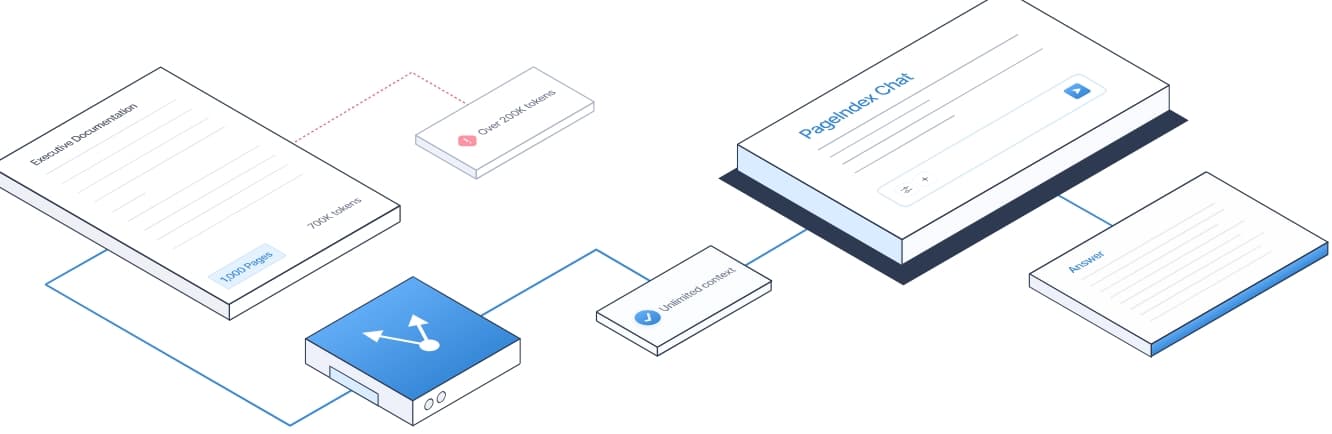
Synthetic summary
PageIndex offers a different way to approach RAG for long, structured documents. Instead of relying only on chunk similarity, it focuses on document structure, reasoned navigation, and more verifiable AI answers.
At first, RAG had a simple promise: connect an AI system to documents so it could answer with sources instead of making things up.
On paper, that is powerful. In practice, it works well for simple content: FAQs, product documentation, customer support articles, short internal notes.
But once you move to long and structured documents, the limits start to show.
An annual report, a contract, a financial appendix or a regulatory document cannot be read like a normal web page. You need to understand the structure, follow references, compare tables, go back to an appendix, and connect several sections together.
That is where PageIndex becomes interesting.
Its goal is not just to help AI read more pages. Its real value is helping AI understand where to read, in what order, and why.
Why classic RAG reaches its limits
Classic RAG usually works like this: a document is split into small pieces called chunks.
Each chunk is then turned into a vector, a mathematical representation of its meaning. When the user asks a question, the system searches for the chunks that are closest to that question.
This works well when the answer is located in a short and clear passage.
For example, if you ask:
How do I reset my password?
The system will probably find the right extract.
But in complex documents, similarity is not enough.
A passage can look similar to the question without being the right one. A table can be separated from its title. A sentence can say “see Appendix G”, while the appendix itself is 80 pages later.